

Artificial Intelligence is quickly becoming part of education, freelancing, business, software development, marketing, and many other careers in Pakistan. Students no longer need to wait until graduation to start learning AI. Even beginners can use modern AI tools to improve productivity, research, creativity, coding, and communication. At the same time, employers are placing greater importance on practical technology skills and the ability to work with emerging tools. HEC’s recent initiatives also show a stronger focus on industry-aligned computing competencies and employability for Pakistani students.
For Pakistani students, learning AI does not necessarily mean becoming a machine-learning engineer. Different students can choose different paths depending on their degree, interests, and career goals. 10 AI Skills Every Student can develop in 2026 include practical abilities such as prompt engineering, AI-powered data analytics, automation, Python, research, content creation, chatbot development, and responsible AI use. These skills can help students perform better academically while also preparing them for internships, freelancing, remote work, and future careers.
Why Should Students Learn AI in 2026?
AI is changing the way people study and work. Students can now use AI to understand difficult concepts, organize information, analyze data, create presentations, write code, research topics, and automate repetitive tasks.
However, simply knowing how to open an AI chatbot is not enough. The real advantage comes from knowing how to use AI correctly and strategically.
UNESCO’s AI competency framework emphasizes that students should not only understand AI but also learn to apply it, create with it, think critically about its results, and use it responsibly.
For students in Pakistan, this creates an opportunity. You can start with beginner-friendly skills and gradually move toward technical AI capabilities.
10 AI Skills Every Student Should Build
We selected the following skills with Pakistani students in mind. They cover both technical and non-technical areas so students from computer science, business, humanities, education, marketing, and other backgrounds can benefit.
1. Prompt Engineering
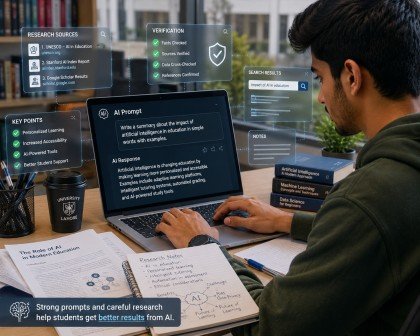
Prompt engineering is one of the easiest AI skills for beginners to start learning. It means creating clear, specific, and well-structured instructions for AI systems so they can produce more useful results.
Instead of asking:
“Write something about marketing.”
A better prompt might explain the audience, purpose, tone, length, keywords, and required format.
Students can use prompt engineering for:
- Creating study notes
- Understanding difficult subjects
- Generating practice questions
- Improving assignments
- Brainstorming ideas
- Writing professional emails
- Creating presentation outlines
- Practicing interviews
Learning 10 AI Skills Every Student should know becomes easier when prompt engineering is treated as a communication skill rather than complicated programming.
How to Improve Prompt Engineering
Students should practice giving AI:
- A clear role
- A specific task
- Relevant background
- Desired output format
- Examples when necessary
- Clear limitations
The goal is not simply to generate more text. The goal is to get better and more useful results.
2. AI-Powered Data Analytics

Data is becoming increasingly important in almost every industry. Students who know how to understand and analyze data can gain an advantage in business, finance, marketing, education, research, and technology.
AI-powered data analytics combines traditional analytical skills with intelligent tools. Students can learn how to clean data, identify patterns, summarize information, create charts, and generate useful insights.
Important tools and technologies include:
- Microsoft Excel
- Power BI
- Python
- SQL
- AI-assisted analytics tools
This is particularly useful for business and commerce students who want to enter technology-related careers without becoming full-time programmers.
Pakistan’s HEC National Skills Competency Test also includes AI, machine learning, Python, data collection, preprocessing, exploratory data analysis, and related areas among its competency areas.
3. No-Code AI and Workflow Automation
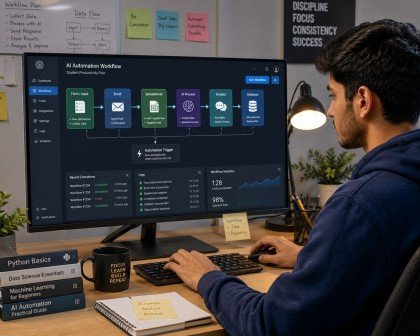
Automation is another highly practical skill for students. It allows repetitive tasks to be completed automatically instead of being performed manually again and again.
For example, a student freelancer could create a workflow that:
- Collects information from a form
- Organizes it in a spreadsheet
- Sends an email
- Updates a database
- Creates a summary using AI
Many automation platforms provide visual interfaces, meaning beginners can build useful workflows without writing large amounts of code.
For Pakistani students, this skill can be especially valuable for freelancing and small online businesses.
Learning automation also teaches students an important professional lesson: look for repetitive problems that technology can solve.
4. Critical AI Output Verification
One of the most important abilities in the age of AI is knowing that AI can make mistakes.
An AI system may produce an answer that sounds confident but contains incorrect facts, outdated information, missing context, or invented references. Students therefore need to develop the habit of checking important information before using it.
This is where critical thinking becomes essential.
Students should learn to:
- Check important facts
- Compare multiple reliable sources
- Verify statistics
- Check references
- Review AI-generated code
- Question unsupported claims
- Avoid submitting unverified AI content
These 10 AI Skills Every Student needs are not only about technology. They are also about developing good judgment.
UNESCO similarly emphasizes critical evaluation, human agency, ethics, privacy, and responsible use of AI in education.
5. Multimodal AI Content Creation
Modern AI is no longer limited to text. Students can work with text, images, audio, presentations, and video.
Multimodal AI skills can help students create:
- Presentation graphics
- Educational videos
- Infographics
- Social media designs
- Voice content
- Video scripts
- Digital portfolios
- Visual study materials
This skill is useful for students interested in digital marketing, graphic design, education, media, freelancing, and entrepreneurship.
However, students should understand copyright, attribution, privacy, and responsible content creation. AI should support creativity rather than encourage students to copy another person’s work.
A strong digital portfolio containing original AI-assisted projects can also help students demonstrate practical ability to potential employers or freelance clients.
6. Basic Python Programming for AI
Students interested in technical careers should consider learning Python.
You do not need to become an advanced programmer immediately. Start with basic concepts such as:
- Variables
- Data types
- Conditions
- Loops
- Functions
- Lists and dictionaries
- File handling
- Basic libraries
After building these foundations, students can explore Python for data analysis, automation, machine learning, and AI applications.
Python is especially valuable because it connects beginner programming with advanced technology. A student can begin by writing a simple automation script and eventually progress toward machine-learning projects.
For computer science, software engineering, AI, and data science students, Python can become one of the most valuable foundations for a long-term technology career.
7. AI Research and Retrieval Skills
Searching for information is changing because students can now combine traditional search engines with AI-powered research systems.
But effective AI research is more than asking a chatbot a question.
Students should learn how to:
- Define a research question
- Search for reliable sources
- Compare information
- Work with uploaded documents
- Extract key findings
- Identify supporting evidence
- Check the original source
- Organize references
Retrieval-augmented approaches can help AI systems work with specific documents and information sources rather than relying only on general model knowledge.
This makes research skills particularly useful for university assignments, academic projects, presentations, and professional reports.
The strongest researchers will not simply ask AI for an answer. They will know where the answer came from and whether it can be trusted.
8. AI Ethics, Privacy, and Responsible Use
Technical knowledge without responsible use can create serious problems.
Students should understand basic AI ethics, including privacy, bias, misinformation, copyright, transparency, academic integrity, and responsible data handling.
For example, students should avoid uploading confidential personal information into AI tools without understanding how that information may be processed.
They should also understand when AI assistance needs to be disclosed according to their institution’s rules.
UNESCO’s guidance recommends a human-centered approach to generative AI, including attention to data privacy, ethical use, safety, equity, and appropriate educational policies.
Responsible AI use can therefore become a genuine professional advantage.
A student who knows both what AI can do and what AI should not do will be better prepared for the workplace.
9. AI Chatbot Development
Chatbots are practical examples of how AI can solve real problems.
Students do not necessarily need advanced programming skills to begin. They can start by understanding:
- Conversation design
- User questions
- Knowledge bases
- Frequently asked questions
- AI instructions
- Basic chatbot testing
- Simple integrations
A student could create a chatbot concept for a university department, online store, tuition academy, small business, or student society.
For freelancers, chatbot development can become a portfolio skill. Instead of simply saying “I know AI,” students can demonstrate an actual project that solves a specific problem.
This project-based approach makes 10 AI Skills Every Student can learn more valuable because employers and clients can see practical results instead of only certificates.
10. Continuous AI Tool Stacking
AI tools are developing quickly. A tool that is popular today may change significantly within a few months.
That is why students should learn how to build a flexible AI tool stack rather than depend completely on one application.
For example, a student might use:
- One AI tool for brainstorming
- Another for research
- Another for design
- Excel or Power BI for analytics
- An automation platform for workflows
- Python for customized tasks
- A writing assistant for proofreading
The important skill is knowing which tool should be used for which problem.
Tool stacking can increase productivity because students do not have to force one AI application to perform every task.
The best approach is to regularly test new tools, compare their strengths, and keep only the ones that genuinely improve your workflow.
How Pakistani Students Can Start Learning AI
Many students feel overwhelmed when they see a long list of AI technologies. The solution is not to learn everything at once.
Start with one skill and create a small project around it.
Beginner Level
Start with:
- Prompt engineering
- AI research
- AI-assisted writing
- AI content creation
- Critical output verification
Intermediate Level
Then move toward:
- Excel and AI analytics
- Power BI
- Workflow automation
- Chatbot development
- More advanced research methods
Technical Level
Students interested in technology can continue with:
- Python
- Machine learning
- Data analytics
- AI APIs
- AI application development
This gradual approach makes learning easier and prevents students from becoming overwhelmed.
Build Projects Instead of Only Collecting Certificates
Certificates can show that you completed a course, but projects demonstrate what you can actually do.
For example, a student could build:
Project 1: An AI study assistant
Project 2: An automated student attendance workflow
Project 3: A Power BI student-performance dashboard
Project 4: An AI-powered FAQ chatbot
Project 5: A research summary system
Project 6: An AI-assisted digital marketing campaign
These projects can become part of a portfolio on a professional profile or personal website.
Pakistan is also seeing stronger efforts to connect computing education with industry competencies and employability. HEC’s 2026 National Skill Competency Test was designed with industry stakeholders and focuses on making computing graduates more market-ready.
AI Skills Can Help Students Prepare for Freelancing
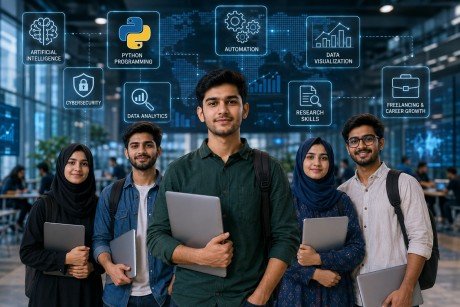
Pakistan has a large and growing digital workforce, and AI creates new opportunities for students who can provide practical services.
Possible freelance services include:
- AI-assisted content creation
- Prompt development
- AI automation
- Data analysis
- Chatbot setup
- AI research
- Presentation creation
- AI-powered marketing
- Basic Python automation
However, students should not expect instant income simply because they learned an AI tool.
Successful freelancing requires communication, problem-solving, portfolio development, client management, reliability, and continuous learning.
AI should be viewed as a career multiplier, not a shortcut to instant money.
AI Skills Should Complement Your Degree
Students do not have to abandon their current field to learn AI.
A business student can combine AI with marketing and analytics. A computer science student can combine AI with Python and software development.
A media student can combine AI with video and content creation. A teacher can combine AI with educational technology. A finance student can combine AI with data analysis.
A humanities student can combine AI with research and communication. This combination creates a powerful concept: domain knowledge + AI skills.
Instead of competing only with people who know the same tools, students can become specialists who understand both AI and a particular industry.
Common Mistakes Students Should Avoid
While developing 10 AI Skills Every Student should learn, students should also avoid common mistakes.
Depending Completely on AI
AI should assist your thinking, not replace it.
Copying AI Answers
Submitting AI-generated work without understanding it can damage academic development and may violate institutional rules.
Ignoring Verification
Always check important facts, particularly in academic and professional work.
Learning Too Many Tools
You do not need 50 AI applications. Master a smaller set of useful tools first.
Focusing Only on Certificates
Practical projects are essential for demonstrating your skills.
Ignoring Privacy
Never casually enter sensitive or confidential information into an AI service.
Benefits of Learning AI Skills in 2026
Learning AI can provide several advantages for Pakistani students.
Better Academic Productivity
Students can use AI for explanations, revision, brainstorming, research organization, and practice.
Stronger Career Preparation
AI knowledge can complement degrees and improve digital confidence.
Freelancing Opportunities
Students can develop services around automation, content, analytics, chatbots, and research.
Remote Work Potential
Digital skills can help students compete for opportunities beyond their local job market.
Better Problem-Solving
AI tools can help students explore multiple approaches to a problem.
Future Readiness
Technology will continue changing, so students who learn how to learn new tools will have an important long-term advantage.
HEC’s current initiatives reflect this broader shift toward future-ready competencies, AI education, and practical industry alignment in Pakistan.
A Simple 6-Month AI Learning Roadmap
Students can follow a simple plan instead of trying to learn everything immediately.
Month 1: Learn AI fundamentals and prompt engineering.
Month 2: Practice AI research, verification, and responsible AI use.
Month 3: Learn Excel, data analysis, and AI-assisted analytics.
Month 4: Explore no-code automation and chatbot development.
Month 5: Start Python fundamentals and build a small technical project.
Month 6: Create a portfolio containing 3–5 practical AI projects.
By the end of six months, students should focus less on how many tools they know and more on the problems they can solve.
What Makes These AI Skills Valuable?
The most useful AI skills have one thing in common: they connect technology with real-world problems.
Knowing how to write a prompt is useful.
Knowing how to use that prompt to solve a client’s problem is more valuable.
Knowing Python is useful.
Using Python to automate a repetitive task is more valuable.
Knowing a chatbot platform is useful.
Building a chatbot that answers real customer questions is more valuable.
This is why students should always ask:
“What can I build with this skill?”
That question can turn AI learning from passive studying into practical career development.
Conclusion
AI is becoming an important part of education and employment, and Pakistani students have a valuable opportunity to prepare early. The goal is not to learn every new AI tool or become an expert overnight. Instead, students should develop practical abilities that improve their productivity, creativity, research, analytical thinking, and career readiness.
The 10 AI Skills Every Student should learn in 2026 provide a balanced starting point: prompt engineering, AI-powered analytics, automation, verification, multimodal creation, Python, research and retrieval, ethics, chatbots, and tool stacking. Students can begin with beginner-friendly skills and gradually progress toward technical AI development.
Most importantly, AI should be used as a learning partner—not as a replacement for human thinking. Students who combine AI with communication, critical thinking, creativity, and strong knowledge of their chosen field will be better positioned for the changing digital economy. The future belongs not simply to people who use AI, but to people who know how to use it intelligently, responsibly, and creatively.
Frequently Asked Questions
1. What AI skill should a Pakistani student learn first?
Prompt engineering is a good starting point because beginners can practice it without advanced programming knowledge and immediately apply it to study, research, and productivity.
2. Do students need programming knowledge to learn AI?
No. Many useful AI skills, including prompting, research, content creation, and automation, can be learned without advanced coding. Students can add Python later for technical careers.
3. Can AI skills help Pakistani students earn online?
Yes. Skills such as automation, data analytics, content creation, chatbot development, and AI-assisted research can support freelancing services, although earning also requires a strong portfolio and professional communication.
4. Is AI going to replace students’ future careers?
AI is more likely to change many tasks within careers than simply eliminate every career. Students who combine AI skills with domain knowledge, creativity, communication, and critical thinking can adapt more effectively.
5. How can students use AI responsibly?
Students should verify important information, protect personal data, avoid plagiarism, follow academic policies, and use AI to support genuine learning rather than simply copying answers. UNESCO also emphasizes human-centered, ethical, safe, and meaningful AI use in education.
Meta Description
Learn the 10 AI Skills Every Student in Pakistan should master in 2026 for better study, freelancing, jobs, and future career growth.Artificial Intelligence is quickly becoming part of education, freelancing, business, software development, marketing, and many other careers in Pakistan. Students no longer need to wait until graduation to start learning AI. Even beginners can use modern AI tools to improve productivity, research, creativity, coding, and communication. At the same time, employers are placing greater importance on practical technology skills and the ability to work with emerging tools. HEC’s recent initiatives also show a stronger focus on industry-aligned computing competencies and employability for Pakistani students.
For Pakistani students, learning AI does not necessarily mean becoming a machine-learning engineer. Different students can choose different paths depending on their degree, interests, and career goals. 10 AI Skills Every Student can develop in 2026 include practical abilities such as prompt engineering, AI-powered data analytics, automation, Python, research, content creation, chatbot development, and responsible AI use. These skills can help students perform better academically while also preparing them for internships, freelancing, remote work, and future careers.
Why Should Students Learn AI in 2026?
AI is changing the way people study and work. Students can now use AI to understand difficult concepts, organize information, analyze data, create presentations, write code, research topics, and automate repetitive tasks.
However, simply knowing how to open an AI chatbot is not enough. The real advantage comes from knowing how to use AI correctly and strategically.
UNESCO’s AI competency framework emphasizes that students should not only understand AI but also learn to apply it, create with it, think critically about its results, and use it responsibly.
For students in Pakistan, this creates an opportunity. You can start with beginner-friendly skills and gradually move toward technical AI capabilities.
10 AI Skills Every Student Should Build
We selected the following skills with Pakistani students in mind. They cover both technical and non-technical areas so students from computer science, business, humanities, education, marketing, and other backgrounds can benefit.
1. Prompt Engineering
Prompt engineering is one of the easiest AI skills for beginners to start learning. It means creating clear, specific, and well-structured instructions for AI systems so they can produce more useful results.
Instead of asking:
“Write something about marketing.”
A better prompt might explain the audience, purpose, tone, length, keywords, and required format.
Students can use prompt engineering for:
- Creating study notes
- Understanding difficult subjects
- Generating practice questions
- Improving assignments
- Brainstorming ideas
- Writing professional emails
- Creating presentation outlines
- Practicing interviews
Learning 10 AI Skills Every Student should know becomes easier when prompt engineering is treated as a communication skill rather than complicated programming.
How to Improve Prompt Engineering
Students should practice giving AI:
- A clear role
- A specific task
- Relevant background
- Desired output format
- Examples when necessary
- Clear limitations
The goal is not simply to generate more text. The goal is to get better and more useful results.
2. AI-Powered Data Analytics
Data is becoming increasingly important in almost every industry. Students who know how to understand and analyze data can gain an advantage in business, finance, marketing, education, research, and technology.
AI-powered data analytics combines traditional analytical skills with intelligent tools. Students can learn how to clean data, identify patterns, summarize information, create charts, and generate useful insights.
Important tools and technologies include:
- Microsoft Excel
- Power BI
- Python
- SQL
- AI-assisted analytics tools
This is particularly useful for business and commerce students who want to enter technology-related careers without becoming full-time programmers.
Pakistan’s HEC National Skills Competency Test also includes AI, machine learning, Python, data collection, preprocessing, exploratory data analysis, and related areas among its competency areas.
3. No-Code AI and Workflow Automation
Automation is another highly practical skill for students. It allows repetitive tasks to be completed automatically instead of being performed manually again and again.
For example, a student freelancer could create a workflow that:
- Collects information from a form
- Organizes it in a spreadsheet
- Sends an email
- Updates a database
- Creates a summary using AI
Many automation platforms provide visual interfaces, meaning beginners can build useful workflows without writing large amounts of code.
For Pakistani students, this skill can be especially valuable for freelancing and small online businesses.
Learning automation also teaches students an important professional lesson: look for repetitive problems that technology can solve.
4. Critical AI Output Verification
One of the most important abilities in the age of AI is knowing that AI can make mistakes.
An AI system may produce an answer that sounds confident but contains incorrect facts, outdated information, missing context, or invented references. Students therefore need to develop the habit of checking important information before using it.
This is where critical thinking becomes essential.
Students should learn to:
- Check important facts
- Compare multiple reliable sources
- Verify statistics
- Check references
- Review AI-generated code
- Question unsupported claims
- Avoid submitting unverified AI content
These 10 AI Skills Every Student needs are not only about technology. They are also about developing good judgment.
UNESCO similarly emphasizes critical evaluation, human agency, ethics, privacy, and responsible use of AI in education.
5. Multimodal AI Content Creation
Modern AI is no longer limited to text. Students can work with text, images, audio, presentations, and video.
Multimodal AI skills can help students create:
- Presentation graphics
- Educational videos
- Infographics
- Social media designs
- Voice content
- Video scripts
- Digital portfolios
- Visual study materials
This skill is useful for students interested in digital marketing, graphic design, education, media, freelancing, and entrepreneurship.
However, students should understand copyright, attribution, privacy, and responsible content creation. AI should support creativity rather than encourage students to copy another person’s work.
A strong digital portfolio containing original AI-assisted projects can also help students demonstrate practical ability to potential employers or freelance clients.
6. Basic Python Programming for AI
Students interested in technical careers should consider learning Python.
You do not need to become an advanced programmer immediately. Start with basic concepts such as:
- Variables
- Data types
- Conditions
- Loops
- Functions
- Lists and dictionaries
- File handling
- Basic libraries
After building these foundations, students can explore Python for data analysis, automation, machine learning, and AI applications.
Python is especially valuable because it connects beginner programming with advanced technology. A student can begin by writing a simple automation script and eventually progress toward machine-learning projects.
For computer science, software engineering, AI, and data science students, Python can become one of the most valuable foundations for a long-term technology career.
7. AI Research and Retrieval Skills
Searching for information is changing because students can now combine traditional search engines with AI-powered research systems.
But effective AI research is more than asking a chatbot a question.
Students should learn how to:
- Define a research question
- Search for reliable sources
- Compare information
- Work with uploaded documents
- Extract key findings
- Identify supporting evidence
- Check the original source
- Organize references
Retrieval-augmented approaches can help AI systems work with specific documents and information sources rather than relying only on general model knowledge.
This makes research skills particularly useful for university assignments, academic projects, presentations, and professional reports.
The strongest researchers will not simply ask AI for an answer. They will know where the answer came from and whether it can be trusted.
8. AI Ethics, Privacy, and Responsible Use
Technical knowledge without responsible use can create serious problems.
Students should understand basic AI ethics, including privacy, bias, misinformation, copyright, transparency, academic integrity, and responsible data handling.
For example, students should avoid uploading confidential personal information into AI tools without understanding how that information may be processed.
They should also understand when AI assistance needs to be disclosed according to their institution’s rules.
UNESCO’s guidance recommends a human-centered approach to generative AI, including attention to data privacy, ethical use, safety, equity, and appropriate educational policies.
Responsible AI use can therefore become a genuine professional advantage.
A student who knows both what AI can do and what AI should not do will be better prepared for the workplace.
9. AI Chatbot Development
Chatbots are practical examples of how AI can solve real problems.
Students do not necessarily need advanced programming skills to begin. They can start by understanding:
- Conversation design
- User questions
- Knowledge bases
- Frequently asked questions
- AI instructions
- Basic chatbot testing
- Simple integrations
A student could create a chatbot concept for a university department, online store, tuition academy, small business, or student society.
For freelancers, chatbot development can become a portfolio skill. Instead of simply saying “I know AI,” students can demonstrate an actual project that solves a specific problem.
This project-based approach makes 10 AI Skills Every Student can learn more valuable because employers and clients can see practical results instead of only certificates.
10. Continuous AI Tool Stacking
AI tools are developing quickly. A tool that is popular today may change significantly within a few months.
That is why students should learn how to build a flexible AI tool stack rather than depend completely on one application.
For example, a student might use:
- One AI tool for brainstorming
- Another for research
- Another for design
- Excel or Power BI for analytics
- An automation platform for workflows
- Python for customized tasks
- A writing assistant for proofreading
The important skill is knowing which tool should be used for which problem.
Tool stacking can increase productivity because students do not have to force one AI application to perform every task.
The best approach is to regularly test new tools, compare their strengths, and keep only the ones that genuinely improve your workflow.
How Pakistani Students Can Start Learning AI
Many students feel overwhelmed when they see a long list of AI technologies. The solution is not to learn everything at once.
Start with one skill and create a small project around it.
Beginner Level
Start with:
- Prompt engineering
- AI research
- AI-assisted writing
- AI content creation
- Critical output verification
Intermediate Level
Then move toward:
- Excel and AI analytics
- Power BI
- Workflow automation
- Chatbot development
- More advanced research methods
Technical Level
Students interested in technology can continue with:
- Python
- Machine learning
- Data analytics
- AI APIs
- AI application development
This gradual approach makes learning easier and prevents students from becoming overwhelmed.
Build Projects Instead of Only Collecting Certificates
Certificates can show that you completed a course, but projects demonstrate what you can actually do.
For example, a student could build:
Project 1: An AI study assistant
Project 2: An automated student attendance workflow
Project 3: A Power BI student-performance dashboard
Project 4: An AI-powered FAQ chatbot
Project 5: A research summary system
Project 6: An AI-assisted digital marketing campaign
These projects can become part of a portfolio on a professional profile or personal website.
Pakistan is also seeing stronger efforts to connect computing education with industry competencies and employability. HEC’s 2026 National Skill Competency Test was designed with industry stakeholders and focuses on making computing graduates more market-ready.
AI Skills Can Help Students Prepare for Freelancing
Pakistan has a large and growing digital workforce, and AI creates new opportunities for students who can provide practical services.
Possible freelance services include:
- AI-assisted content creation
- Prompt development
- AI automation
- Data analysis
- Chatbot setup
- AI research
- Presentation creation
- AI-powered marketing
- Basic Python automation
However, students should not expect instant income simply because they learned an AI tool.
Successful freelancing requires communication, problem-solving, portfolio development, client management, reliability, and continuous learning.
AI should be viewed as a career multiplier, not a shortcut to instant money.
AI Skills Should Complement Your Degree
Students do not have to abandon their current field to learn AI.
A business student can combine AI with marketing and analytics.
A computer science student can combine AI with Python and software development.
A media student can combine AI with video and content creation.
A teacher can combine AI with educational technology.
A finance student can combine AI with data analysis.
A humanities student can combine AI with research and communication.
This combination creates a powerful concept: domain knowledge + AI skills.
Instead of competing only with people who know the same tools, students can become specialists who understand both AI and a particular industry.
Common Mistakes Students Should Avoid
While developing 10 AI Skills Every Student should learn, students should also avoid common mistakes.
Depending Completely on AI
AI should assist your thinking, not replace it.
Copying AI Answers
Submitting AI-generated work without understanding it can damage academic development and may violate institutional rules.
Ignoring Verification
Always check important facts, particularly in academic and professional work.
Learning Too Many Tools
You do not need 50 AI applications. Master a smaller set of useful tools first.
Focusing Only on Certificates
Practical projects are essential for demonstrating your skills.
Ignoring Privacy
Never casually enter sensitive or confidential information into an AI service.
Benefits of Learning AI Skills in 2026
Learning AI can provide several advantages for Pakistani students.
Better Academic Productivity
Students can use AI for explanations, revision, brainstorming, research organization, and practice.
Stronger Career Preparation
AI knowledge can complement degrees and improve digital confidence.
Freelancing Opportunities
Students can develop services around automation, content, analytics, chatbots, and research.
Remote Work Potential
Digital skills can help students compete for opportunities beyond their local job market.
Better Problem-Solving
AI tools can help students explore multiple approaches to a problem.
Future Readiness
Technology will continue changing, so students who learn how to learn new tools will have an important long-term advantage.
HEC’s current initiatives reflect this broader shift toward future-ready competencies, AI education, and practical industry alignment in Pakistan.
A Simple 6-Month AI Learning Roadmap
Students can follow a simple plan instead of trying to learn everything immediately.
Month 1: Learn AI fundamentals and prompt engineering.
Month 2: Practice AI research, verification, and responsible AI use.
Month 3: Learn Excel, data analysis, and AI-assisted analytics.
Month 4: Explore no-code automation and chatbot development.
Month 5: Start Python fundamentals and build a small technical project.
Month 6: Create a portfolio containing 3–5 practical AI projects.
By the end of six months, students should focus less on how many tools they know and more on the problems they can solve.
What Makes These AI Skills Valuable?
The most useful AI skills have one thing in common: they connect technology with real-world problems.
Knowing how to write a prompt is useful.
Knowing how to use that prompt to solve a client’s problem is more valuable.
Knowing Python is useful.
Using Python to automate a repetitive task is more valuable.
Knowing a chatbot platform is useful.
Building a chatbot that answers real customer questions is more valuable.
This is why students should always ask:
“What can I build with this skill?”
That question can turn AI learning from passive studying into practical career development.
Conclusion
AI is becoming an important part of education and employment, and Pakistani students have a valuable opportunity to prepare early. The goal is not to learn every new AI tool or become an expert overnight. Instead, students should develop practical abilities that improve their productivity, creativity, research, analytical thinking, and career readiness.
The 10 AI Skills Every Student should learn in 2026 provide a balanced starting point: prompt engineering, AI-powered analytics, automation, verification, multimodal creation, Python, research and retrieval, ethics, chatbots, and tool stacking. Students can begin with beginner-friendly skills and gradually progress toward technical AI development.
Most importantly, AI should be used as a learning partner—not as a replacement for human thinking. Students who combine AI with communication, critical thinking, creativity, and strong knowledge of their chosen field will be better positioned for the changing digital economy. The future belongs not simply to people who use AI, but to people who know how to use it intelligently, responsibly, and creatively.
Frequently Asked Questions
1. What AI skill should a Pakistani student learn first?
Prompt engineering is a good starting point because beginners can practice it without advanced programming knowledge and immediately apply it to study, research, and productivity.
2. Do students need programming knowledge to learn AI?
No. Many useful AI skills, including prompting, research, content creation, and automation, can be learned without advanced coding. Students can add Python later for technical careers.
3. Can AI skills help Pakistani students earn online?
Yes. Skills such as automation, data analytics, content creation, chatbot development, and AI-assisted research can support freelancing services, although earning also requires a strong portfolio and professional communication.
4. Is AI going to replace students’ future careers?
AI is more likely to change many tasks within careers than simply eliminate every career. Students who combine AI skills with domain knowledge, creativity, communication, and critical thinking can adapt more effectively.
5. How can students use AI responsibly?
Students should verify important information, protect personal data, avoid plagiarism, follow academic policies, and use AI to support genuine learning rather than simply copying answers. UNESCO also emphasizes human-centered, ethical, safe, and meaningful AI use in education.
Meta Description:
Learn the 10 AI Skills Every Student in Pakistan should master in 2026 for better study, freelancing, jobs, and future career growth.
- Why Should Students Learn AI in 2026?
- 10 AI Skills Every Student Should Build
- 1. Prompt Engineering
- How to Improve Prompt Engineering
- 2. AI-Powered Data Analytics
- 3. No-Code AI and Workflow Automation
- 4. Critical AI Output Verification
- 5. Multimodal AI Content Creation
- 6. Basic Python Programming for AI
- 7. AI Research and Retrieval Skills
- 8. AI Ethics, Privacy, and Responsible Use
- 9. AI Chatbot Development
- 10. Continuous AI Tool Stacking
- How Pakistani Students Can Start Learning AI
- Build Projects Instead of Only Collecting Certificates
- AI Skills Can Help Students Prepare for Freelancing
- AI Skills Should Complement Your Degree
- Common Mistakes Students Should Avoid
- Benefits of Learning AI Skills in 2026
- A Simple 6-Month AI Learning Roadmap
- What Makes These AI Skills Valuable?
- Conclusion
- Why Should Students Learn AI in 2026?
- 10 AI Skills Every Student Should Build
- 1. Prompt Engineering
- How to Improve Prompt Engineering
- 2. AI-Powered Data Analytics
- 3. No-Code AI and Workflow Automation
- 4. Critical AI Output Verification
- 5. Multimodal AI Content Creation
- 6. Basic Python Programming for AI
- 7. AI Research and Retrieval Skills
- 8. AI Ethics, Privacy, and Responsible Use
- 9. AI Chatbot Development
- How Pakistani Students Can Start Learning AI
- Build Projects Instead of Only Collecting Certificates
- AI Skills Can Help Students Prepare for Freelancing
- AI Skills Should Complement Your Degree
- Common Mistakes Students Should Avoid
- Benefits of Learning AI Skills in 2026
- A Simple 6-Month AI Learning Roadmap
- What Makes These AI Skills Valuable?
- Conclusion
- Meta Description: