
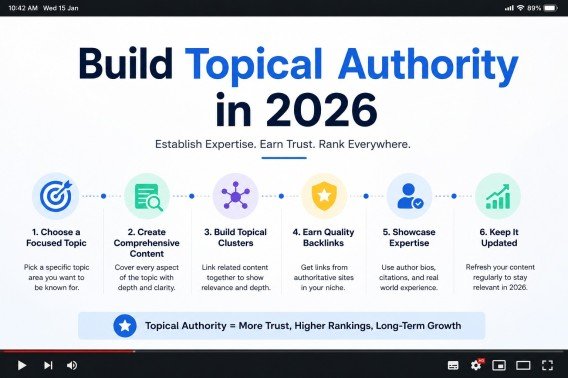
Search engine optimization has evolved significantly, and in 2026, ranking on Google requires much more than keywords and backlinks. Search engines now prioritize expertise, topic depth, and content relevance across an entire website. This shift has made topical authority one of the most important factors for sustainable SEO success. If you want to Build Topical Authority in 2026, your goal should be to become the most trusted source within your niche. Websites that Build Topical Authority in 2026 cover topics comprehensively, connect related content effectively, and provide complete answers to user questions.
As a result, they enjoy stronger rankings, faster indexing, and greater visibility in Google AI Overviews and AI-powered search platforms. To Build Topical Authority in 2026, businesses need a strategic approach that includes topic clusters, topical maps, internal linking, and intent-focused content. Sites that consistently Build Topical Authority in 2026 gain long-term authority, attract qualified traffic, and outperform competitors in both traditional search results and AI-generated answers.
What Is Topical Authority?
Topical authority refers to a website’s ability to demonstrate expertise and trustworthiness on a specific subject. Rather than focusing on individual keywords, topical authority focuses on comprehensive topic coverage.
For example, a website about digital marketing should cover SEO, content marketing, social media, email marketing, local SEO, analytics, and related topics. This broad yet connected coverage helps search engines understand the site’s expertise.
When Google recognizes a website as an authority, it becomes easier for new content to rank because trust has already been established.
Why Topical Authority Matters in 2026
Better Search Rankings
Websites with strong Topical Expertise often rank higher because search engines trust their content. Google prefers sources that consistently publish valuable information about a subject.
Improved AI Search Visibility
AI-powered search tools like ChatGPT, Gemini, and Google AI Overviews frequently cite websites that demonstrate expertise through comprehensive topic coverage.
Faster Indexing
Authoritative websites are crawled more frequently, allowing new content to appear in search results faster.
Long-Term SEO Growth
Unlike temporary SEO tactics, topical authority creates a sustainable competitive advantage that continues generating traffic over time.
Understanding Topic Clusters
What Are Topic Clusters?
Topic clusters are groups of related content connected around a central pillar page. They help search engines understand the relationship between different pieces of content.
For example:
Pillar Topic:
Digital Marketing
Supporting Topics:
- SEO Basics
- Content Marketing
- Social Media Marketing
- Email Marketing
- Local SEO
- PPC Advertising
Each supporting article links back to the pillar page and to other related content.
Why Topic Clusters Work
Topic clusters improve navigation, strengthen internal linking, and help search engines identify expertise.
Understanding Topical Maps
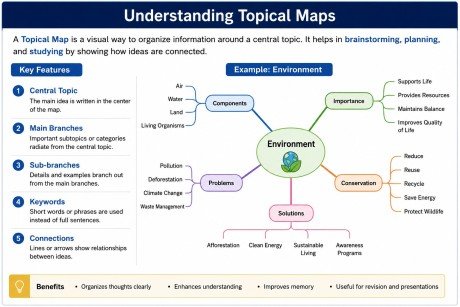
What Is a Topical Map?
A topical map is a strategic content plan that outlines every important subtopic within a niche.
Instead of randomly publishing articles, a topical map helps you organize content logically.
SEO example:
Main Topic:
SEO
Subtopics:
- Technical SEO
- On-Page SEO
- Off-Page SEO
- Local SEO
- AI SEO
- Content Optimization
- Link Building
This structure ensures complete coverage.
Benefits of Using a Topical Map
- Prevents content gaps
- Improves planning
- Strengthens topical relevance
- Enhances user experience
- Supports long-term authority building
How to Build Topical Authority Step by Step
Step 1: Choose a Focused Niche
Avoid covering unrelated topics.
Instead of writing about marketing, finance, health, and technology together, focus on one primary niche.
The narrower your focus, the easier it becomes to establish expertise.
Step 2: Perform Comprehensive Keyword Research
Research all questions your audience may ask.
Use tools such as:
- Google Search
- Google Search Console
- Ahrefs
- Semrush
- AnswerThePublic
Look beyond high-volume keywords and identify informational queries.
Step 3: Create a Pillar Page
A pillar page serves as the foundation of your topic cluster.
It should provide a broad overview of the topic while linking to detailed supporting articles.
Step 4: Publish Supporting Content
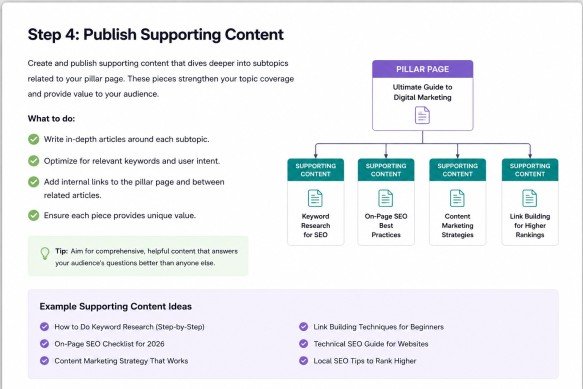
Create detailed articles addressing individual subtopics.
Each article should answer a specific user question thoroughly.
Step 5: Build Strong Internal Links
Internal linking connects related content and helps search engines understand relationships between pages.
Best practices include:
- Using descriptive anchor text
- Linking to relevant pages
- Updating older articles with new links
Step 6: Cover User Intent
Understanding Search Intent: The Key to Better SEO Rankings
One of the most important SEO strategies in 2026 is matching your content with the user’s search intent. Search intent is the reason behind a user’s search query. When your content satisfies what users are looking for, Google is more likely to rank it higher.
1. Informational Intent
Goal: Users are looking for information, answers, or guidance.
These users want to learn something rather than buy a product or service. They search for tutorials, definitions, tips, or step-by-step guides.
Examples:
- What is Topical Authority?
- How to improve website SEO?
- How does Google ranking work?
Best Content Types:
- Blog posts
- How-to guides
- Tutorials
- Educational articles
- FAQs
SEO Tip: Write clear, detailed, and well-structured content that completely answers the user’s question.
2. Navigational Intent
Goal: Users want to visit a specific website, brand, or webpage.
Instead of searching the exact URL, users type the brand or website name into Google.
Examples:
- Google Search Console
- WordPress Login
- Ahrefs Blog
- YouTube Studio
Best Content Types:
- Brand pages
- Homepage
- Landing pages
- Official documentation
SEO Tip: Optimize your brand name, page titles, and meta descriptions so users can easily find your website.
3. Commercial Intent
Goal: Users are researching and comparing options before making a decision.
These users are interested in buying but want to compare products, services, or tools first.
Examples:
- Best SEO tools in 2026
- Ahrefs vs Semrush
- Best WordPress hosting
- Top digital marketing courses
Best Content Types:
- Comparison articles
- Product reviews
- “Best of” lists
- Buying guides
SEO Tip: Include pros and cons, feature comparisons, pricing information, and honest recommendations to help users make informed decisions.
4. Transactional Intent
Goal: Users are ready to take action, such as buying a product, registering for a course, or requesting a service.
These users have already done their research and are prepared to complete a purchase or sign up.
Examples:
- Buy SEO course online
- Enroll in a digital marketing course
- Download SEO checklist
- Hire an SEO expert
Best Content Types:
- Product pages
- Service pages
- Sales pages
- Registration or checkout pages
SEO Tip: Add strong calls to action (CTAs), clear pricing, trust signals, testimonials, and an easy checkout or registration process to increase conversions.
Why Search Intent Matters
Google’s main goal is to show users the most relevant content for their search. If your content matches the user’s intent, visitors are more likely to stay on your page, engage with your content, and take action. This leads to better user experience, higher engagement, improved rankings, and increased organic traffic.
Before creating any content, always ask yourself:
“What is the user actually trying to achieve with this search?”
When your content answers that question effectively, your chances of ranking on Google’s first page become much stronger.
Step 7: Update Content Regularly
Fresh content signals relevance.
Review older articles periodically and update:
- Statistics
- Examples
- Screenshots
- SEO recommendations
Common Mistakes That Prevent Topical Authority
Publishing Random Content
Unrelated articles dilute topical relevance.
Ignoring Internal Linking
Without internal links, search engines struggle to understand content relationships.
Creating Thin Content
Short, low-quality articles rarely establish expertise.
Focusing Only on Keywords
Keyword stuffing is outdated. Focus on solving user problems instead.
Neglecting Content Updates
Outdated information can reduce trust and rankings.
How AI Search Is Changing Topical Authority
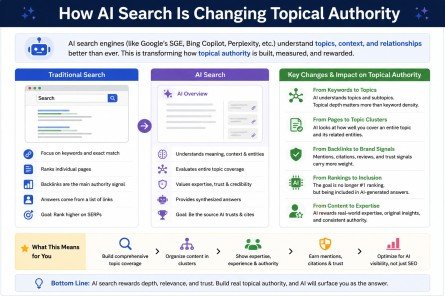
AI search platforms evaluate websites differently than traditional search engines.
They prefer content that:
- Answers questions directly
- Uses clear structure
- Provides comprehensive coverage
- Includes supporting evidence
As AI adoption grows, Topical Expertise becomes even more valuable.
Websites with strong topical authority are more likely to appear in:
- Google AI Overviews
- ChatGPT Citations
- Gemini Results
- Perplexity Answers
Measuring Topical Authority
Keyword Coverage
Track how many related keywords your website ranks for.
Organic Traffic Growth
Monitor topic-specific traffic increases.
Internal Link Strength
Evaluate connections between related content.
AI Search Mentions
Track citations from AI platforms and search features.
Search Console Data
Analyze impressions, clicks, and ranking improvements.
Conclusion
Topical authority has become one of the most important SEO strategies in 2026. Search engines no longer reward websites that simply target keywords or accumulate backlinks. Instead, they prioritize websites that demonstrate expertise through comprehensive content coverage, logical structure, and consistent publishing.
By creating topic clusters, building topical maps, strengthening internal links, and focusing on user intent, you can establish your website as a trusted authority in your niche. The websites that invest in topical authority today will enjoy stronger rankings, increased visibility, and long-term organic growth in both traditional search engines and AI-powered search platforms.
Frequently Asked Questions (FAQs)
What is topical authority in SEO?
Topical authority is the process of becoming a trusted expert on a specific subject by covering all important aspects of that topic through high-quality content.
How long does it take to build topical authority?
Most websites begin seeing results within 3 to 6 months, while significant authority typically develops over 12 to 24 months.
Are backlinks still important?
Yes, backlinks still matter, but topical authority often has a greater impact on long-term ranking stability and relevance.
What is the difference between topical authority and domain authority?
Domain authority measures overall website strength, while Content Authority measures expertise within a specific subject area.
Can small websites build topical authority?
Absolutely. Many niche websites outrank larger brands by focusing deeply on one topic and creating comprehensive content.
Why are topic clusters important?
Topic clusters help search engines understand content relationships and strengthen overall topical relevance.
Meta Description
Build topical authority in 2026 with topic clusters, topical maps, and internal linking to boost Google rankings and AI visibility.