
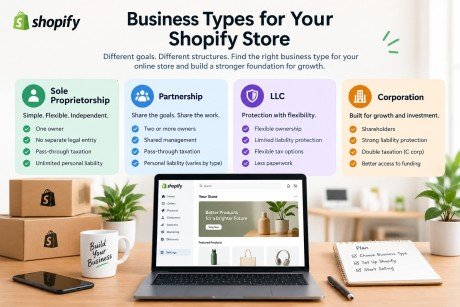
Choosing the right business structure is an important step when building an online store. Your decision can affect personal liability, taxes, ownership, documentation, payment setup, and the way your business grows. Shopify lets merchants add business information and identify whether they are selling as an individual or through a registered business. The correct details also help keep legal and payment information consistent. This choice can influence your store setup, financial services, compliance, and long-term business decisions.
Understanding the business type on Shopify is especially useful before you complete Shopify Payments or other financial services. Your available registration choices can depend on the country where you operate and whether your business is registered. This guide explains the main structures, how to compare them, and how to enter the correct information in Shopify without making common setup mistakes before you submit information.
Why Your Business Type Matters on Shopify
Your legal structure is more than a label inside an ecommerce dashboard. It describes who owns the business, who is responsible for its obligations, how profits may be taxed, and what documentation you may need. Choosing the business type on Shopify should therefore begin with your real legal status, not with the option that simply sounds most convenient.
For example, a person testing a small online idea may operate as an individual or sole proprietor, while a formally registered company may need to select a registered business option and provide its legal name and supporting documents. Shopify states that business entity information depends on the operating country, whether you sell as an individual or registered business, and the type of registered business you operate.
Common Business Types for Shopify Sellers
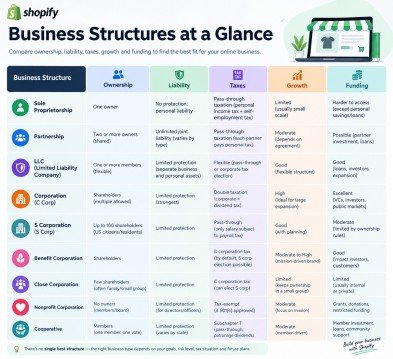
Different business structures offer different levels of ownership flexibility, liability protection, taxation, and administrative responsibility. Before selecting an option, understand what each structure means for your store.
1. Sole Proprietorship
A sole proprietorship is a business owned and controlled by one person. It is often one of the simplest structures for a new entrepreneur because the same individual owns and manages it.
The main advantage is simplicity. You can make decisions independently and usually have fewer formal requirements than a corporation. However, depending on local law, the owner may have unlimited personal liability for business debts and legal claims. That means personal assets can be exposed if the business faces serious financial or legal problems.
A sole proprietorship may suit a low-risk side business, freelancer, or beginner who is testing an idea. Before selecting this option, make sure it accurately reflects your legal registration in your country.
2. Partnership
A partnership is generally owned by two or more people. Partners can contribute money, skills, property, or work and share profits according to their agreement.
A general partnership can be relatively simple to establish, but partners may have significant personal liability. A limited partnership separates active general partners from limited partners, while a limited liability partnership (LLP) can provide different protections depending on local rules.
If several people are starting a Shopify store together, a written partnership agreement is important. It should explain ownership percentages, responsibilities, profit sharing, decision-making, and what happens if a partner leaves.
3. Limited Liability Company (LLC)
An LLC combines features commonly associated with partnerships and corporations. In jurisdictions such as the United States, it can provide limited liability protection while offering flexible tax treatment.
For many small ecommerce businesses, an LLC can be attractive because it separates the business from the owner’s personal assets while avoiding some of the formalities associated with corporations. Tax treatment varies, and an LLC may have different default and elective tax classifications.
The business type on Shopify should match the LLC’s actual legal registration and documentation. Do not select LLC simply because you want liability protection; you should have the corresponding legal entity where required.
4. Corporation
A corporation is a separate legal entity from its owners. It generally provides limited liability protection and can make it easier to structure ownership through shares.
Corporations can be useful for businesses planning significant expansion, outside investment, or more complex ownership. The tradeoff is greater administrative work, recordkeeping, governance, and compliance.
In the United States, common corporate tax classifications include C corporation and S corporation. A C corporation is generally subject to corporate income tax, while an eligible S corporation generally uses pass-through federal taxation. Rules and eligibility requirements can change, so business owners should check current tax guidance.
C Corporation
A C corporation is commonly used by businesses seeking venture capital or institutional investment. It can issue different classes of stock and has no general limit on the number of shareholders.
Its major disadvantage for some owners is potential double taxation: the corporation may pay tax on profits and shareholders may pay tax on dividends. Corporate formation and ongoing compliance can also be more demanding.
S Corporation
An S corporation is a US federal tax election rather than a separate state-law business structure. Eligible corporations or LLCs can elect S corporation tax treatment under applicable rules.
This can provide pass-through taxation and may offer payroll-tax planning opportunities for qualifying owner-employees. However, strict eligibility and payroll requirements apply, so professional tax advice is valuable.
5. Benefit Corporation
A benefit corporation is a for-profit corporate structure designed to pursue public benefit alongside financial goals where recognized by applicable law. It may suit a mission-driven ecommerce brand focused on social or environmental impact.
This structure should not be confused with B Corp certification. Legal benefit corporation status and third-party B Corp certification are separate concepts.
6. Nonprofit Corporation
A nonprofit corporation is created for a qualifying mission rather than distributing profits to owners. Depending on the jurisdiction and tax status, nonprofits may be eligible for special tax treatment.
This structure is generally unsuitable for an ordinary commercial Shopify store. It may make sense for an eligible charitable, educational, religious, or community-focused organization that uses Shopify for appropriate activities.
7. Cooperative
A cooperative is owned and democratically controlled by its members. Depending on the model, members may be customers, workers, producers, or other participating groups.
Cooperatives can work well for collective ecommerce ventures, shared marketplaces, or producer-owned businesses. They are less common for a single entrepreneur because governance and membership requirements can add complexity.
How to Compare Business Types
Before choosing the business type on Shopify, compare your options using a few practical questions.
| Factor | What to Consider |
| Ownership | Are you the only owner, or are there partners or shareholders? |
| Liability | How much personal asset protection do you need? |
| Taxes | How will business income be taxed in your jurisdiction? |
| Administration | How much paperwork and recordkeeping can you manage? |
| Growth | Do you plan to hire, add owners, or seek investors? |
| Funding | Will you need loans, outside investment, or venture capital? |
| Documentation | What registration certificates and identification can you provide? |
There is no single structure that is best for every seller. A small low-risk business may prioritize simplicity, while a product company with employees, inventory, and higher liability exposure may prioritize legal separation and protection.
How to Choose Your Business Type on Shopify
The safest approach is to start with your legal documents and then match the Shopify option to them. Do not choose a structure based only on tax advantages or what another seller uses.
Step 1: Identify Your Actual Legal Status
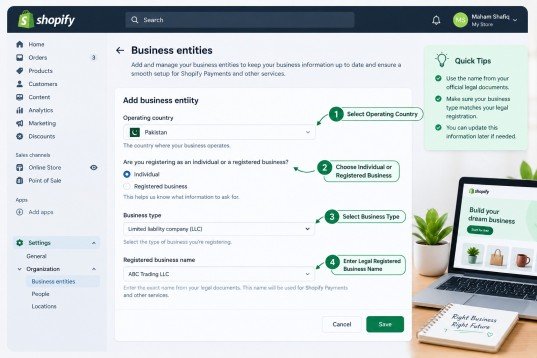
First, decide whether you are selling as an individual or through a registered business. If your business is registered, identify the exact legal structure shown on your official documents.
Step 2: Check Your Operating Country
Shopify asks for the country where your business operates. The available registration options and information requirements can vary by country. Shopify’s current guidance confirms that the information required for a business entity depends partly on the operating country.
Step 3: Select Individual or Registered Business
If you are operating personally without a registered business, select the individual option when that is the correct choice for your country. If you have a registered company, select the registered business option and then choose the appropriate structure.
This is a key part of the business type on Shopify setup because Shopify may request different information based on the selection.
Step 4: Enter Your Legal Business Name
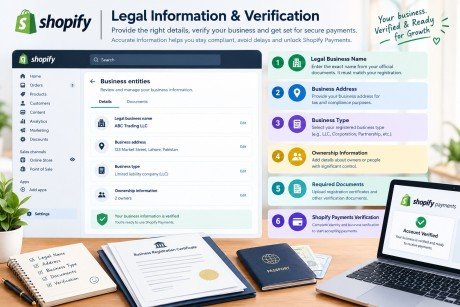
For a registered business, enter the legal registered name exactly as it appears on your official documentation. Shopify specifically states that the registered business name must match the name on legal documents.
Avoid using a shortened brand name, nickname, or social media name when Shopify asks for your legal business name.
Step 5: Add Business Address and Required People
Depending on your setup, Shopify may request the business address and information about people who ultimately own or control the business. It can also request an account representative and verification documents.
Make sure these details are accurate and consistent with your official records.
Step 6: Review Your Information Before Saving
Before clicking Save, check spelling, legal names, addresses, registration type, and supporting documents. Small mismatches can create verification problems later.
Step 7: Complete Payment Setup Carefully
If you use Shopify Payments, business information becomes especially important. Shopify’s payment documentation explains that the business type affects the information you need to provide. For registered entities, the business type listed in organization settings can also populate the corresponding business type during Shopify Payments setup.
Where to Add or Update Business Information in Shopify
Shopify’s current Help Center provides two relevant paths depending on your setup.
For a store’s business details, go to Settings > General, then find the Business details section. Shopify allows merchants to manage legal business information there.
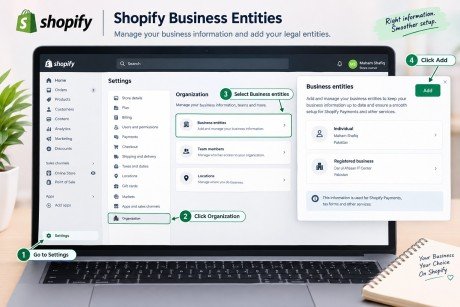
If your store is part of an organization and you have access to organization settings, business entities can be managed from Settings > Organization > Business entities. From there, you can add a business entity and provide the country, registration type, business type, legal name, address, ownership information, and required documents.
The exact options shown can vary according to your country and business situation, so your admin screen may not look identical to another merchant’s screen.
Common Mistakes to Avoid
Choosing a Business Type That Is Not Your Legal Structure
Do not select LLC, corporation, partnership, or another option simply because it seems more professional. The selection should reflect your actual legal status.
Using a Brand Name Instead of a Legal Name
Your storefront name and legal business name can be different. When Shopify requests the registered business name, use the name shown on official documents.
Ignoring Country-Specific Requirements
Business structures and tax rules vary between countries. A structure that is common in the United States may not work the same way in another jurisdiction.
Mixing Personal and Business Information
Keep your legal business details consistent across registration records, payment information, banking records, and Shopify.
Choosing Based Only on Taxes
Taxes are important, but liability, ownership, compliance, funding, and growth plans also matter. A structure with a lower tax burden is not automatically the best structure for your business.
Which Business Type Is Best for a Shopify Store?
For a solo beginner, an individual or sole proprietorship structure may be the simplest starting point when legally appropriate. For a growing business that needs liability separation, an LLC or equivalent local structure may be worth considering. Businesses expecting major outside investment may eventually prefer a corporate structure.
The best business type on Shopify is therefore the one that accurately represents your legal business and supports your current goals. If you are unsure, speak with a qualified business lawyer or tax professional in your jurisdiction before registering or changing your structure.
Quick Checklist Before Selecting Your Business Type
- Confirm your operating country.
- Decide whether you are an individual or registered business.
- Check your official registration documents.
- Identify your exact legal structure.
- Use your legal registered business name.
- Prepare address, ownership, and verification information.
- Make sure Shopify and legal documents match.
- Review payment requirements before submitting information.
Following these steps can make the business type on Shopify setup smoother and reduce avoidable verification issues.
Conclusion
Choosing a business structure is an important part of creating a strong ecommerce foundation. Sole proprietorships can offer simplicity, partnerships can support shared ownership, LLCs can provide flexibility and liability protection where available, and corporations can support more complex ownership and funding plans. The right choice depends on your legal status, risk level, tax situation, and future goals.
When you set up Shopify, accuracy matters just as much as the structure itself. Use your real legal information, select the registration type that matches your documents, and keep business and payment details consistent. If you are uncertain about your legal structure or tax obligations, professional advice can help you make a decision that fits your situation.
FAQs
1. Can I change my business type on Shopify later?
Yes. Business entity details can be edited in Shopify, but changes may require updated information or documentation and can affect payment verification.
2. What business type should a new Shopify seller choose?
Choose the structure you are legally operating under, such as an individual, sole proprietorship, LLC, partnership, or corporation.
3. Does Shopify require a registered company?
Not always. Shopify supports merchants operating as individuals, while registered businesses need to provide the relevant legal business information.
4. Why must my Shopify business name match my documents?
Matching legal information helps Shopify verify your business and can prevent issues during business or payment verification.
5. Is an LLC automatically the best option for Shopify?
No. An LLC can be useful for some businesses, but the best structure depends on your country, liability exposure, taxes, ownership, and growth plans.
Meta Description
Learn how to choose your business type on Shopify, compare structures, enter legal details, and avoid setup and payment verification issues.